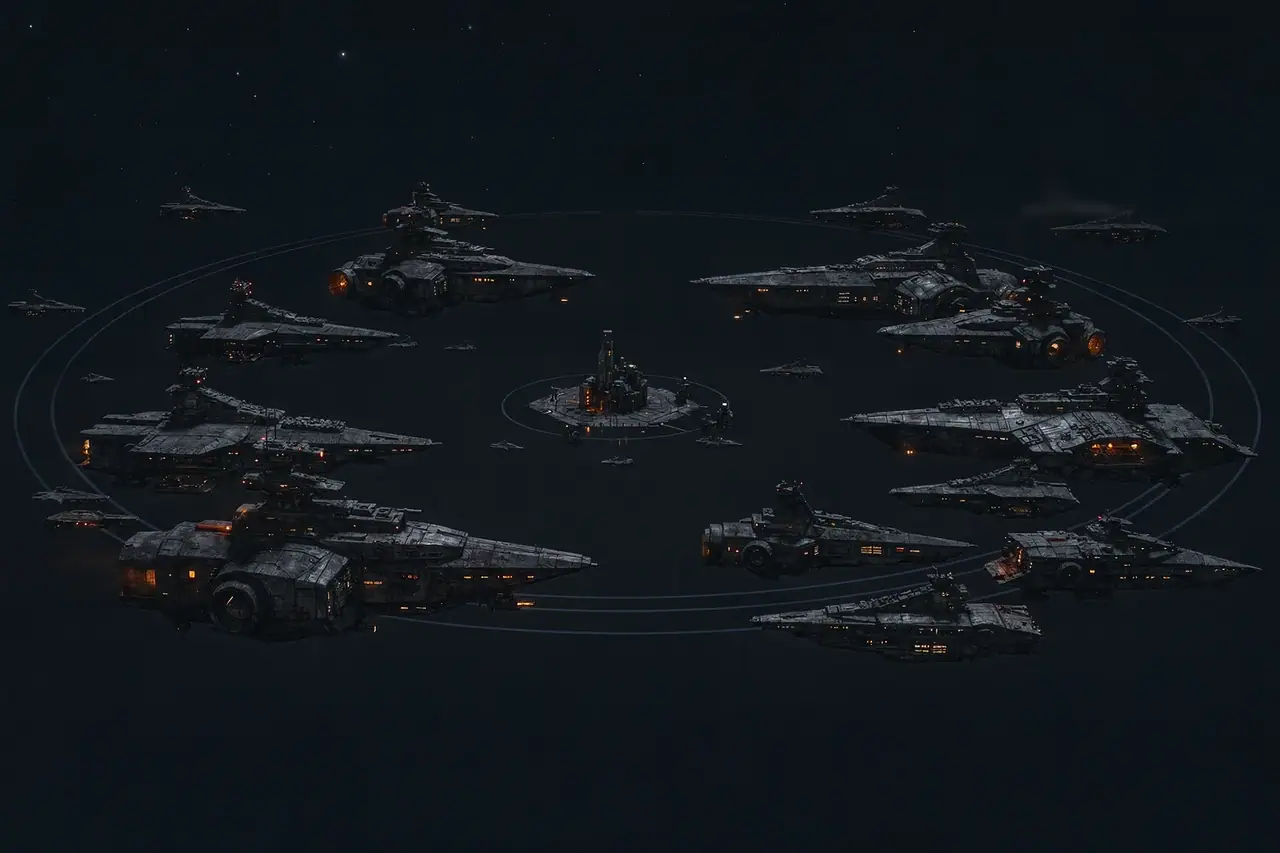
The Front Moves House
The earliest readings put six systems under contest, spread across 2EV-BA, 80G-H5, HLR-GL, JUE-DX, M1-PX9 and W9-TFD. Over the next days that list thinned steadily, from six to five, then to two, then to a single system, 2EV-BA, where one reading tipped hard against the defenders. Then the tracker showed none of those systems at all. No sovereignty changed hands anywhere in this record, so what the history actually shows is pressure relocating rather than a conquest completing. By 24 September a different pair, 6-GRN7 and TFPT-U, was under contest, and hours later the list had grown to eight. The old front did not resolve. It was abandoned in favour of a new one.
Eight Infrastructure Fights, One Defender
Every system currently on the list is an ihub defense. This is the signature of an invasion that wants structures rather than a scrap, and it is being run against a single defender across eight separate contests: 6-GRN7, I-HRX3, J4AQ-O, M4U-EH, O-O2GN, QHH-13, TFPT-U and WK2F-Y. Holding one infrastructure fight is a scheduling problem. Holding eight at once is a different kind of problem, and it falls on Lunar Luminescence to solve it without ceding any of them.
Pressure Without Conversion
Here is the odd part. The footprint has grown, the activity is marked as escalating, and yet the balance between the two sides has barely shifted across the whole record. Attackers hold the smaller share of each contest, defenders the larger, and the drift between readings is flat. Nothing is converting. Six days of escalation have produced a wider front but not a decisive one, which is why the campaign reads as defensive despite all that activity: the defender is absorbing the pressure rather than collapsing under it. A grinding stalemate funded by someone else's ISK.
TFPT-U Becomes the Axis
Among the new cluster, one system keeps drawing the tracker's attention. TFPT-U appeared alongside 6-GRN7 when the front reopened and has stayed the hottest system through the most recent readings, even as six more contests joined it. If the current phase has a centre of gravity, that is where it sits. The rest of the new systems have the look of a spread rather than a concentration, which is worth watching: pressure that fans out across eight systems is harder to finish than pressure applied to one.
What Eight Open Contests Cost
Two things can be true of a front this wide. For the defender, it splits attention, stretches response, and forces unpalatable choices about which infrastructure fight matters most. For the attacker, six days of escalating pressure that has moved no sovereignty is its own kind of bill. Whether the new cluster represents a second wave or simply the same campaign finding fresh targets is not something the data settles. What is clear is that Outer Passage is more contested tonight than it was yesterday, and nobody has yet found a way to make that count.